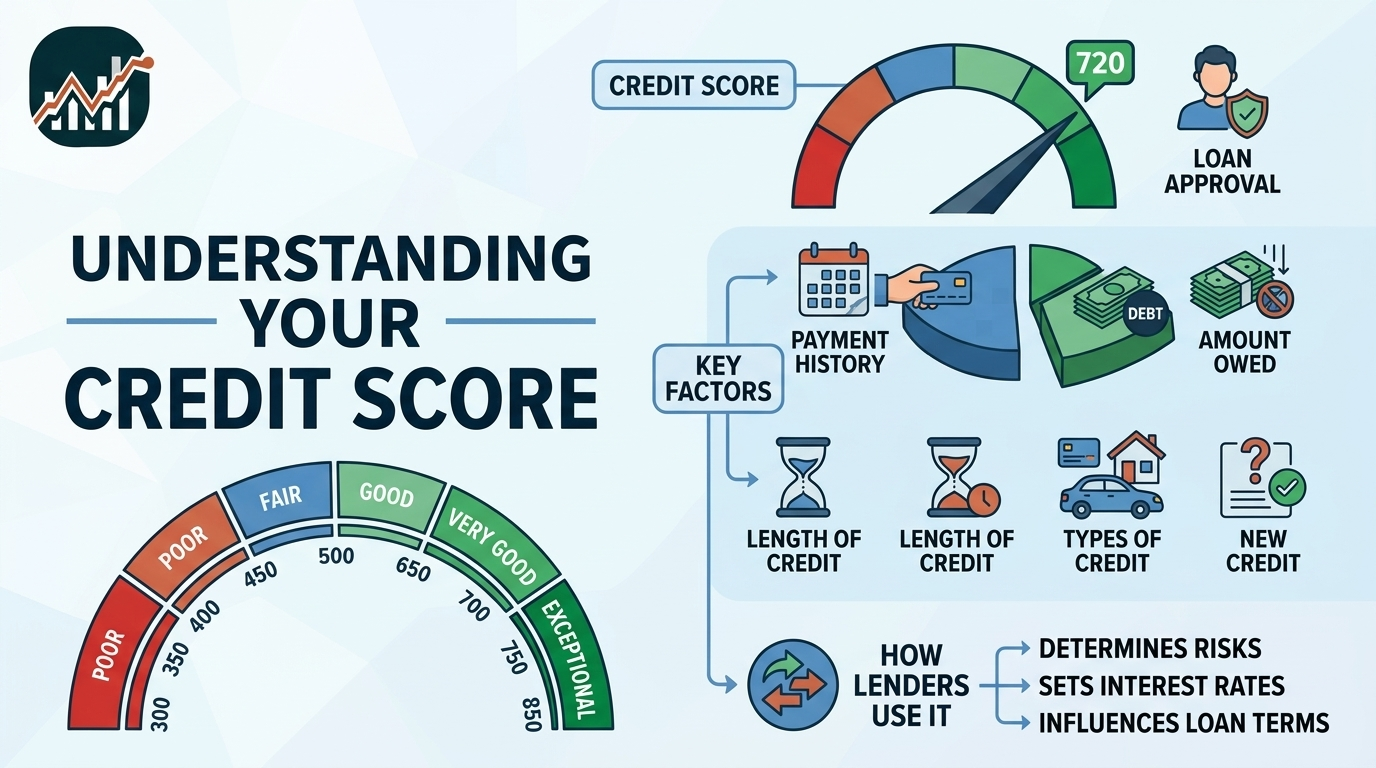
A credit score is a three-digit number that converts a borrower’s credit history into a single measure of repayment risk. Lenders use it, alongside income and affordability checks, when deciding whether to approve a loan, credit card, or mortgage and on what terms.
The number itself carries no meaning until you know which scoring model produced it. A score of 700 sits in the good band under FICO’s 300–850 scale, but the same figure means something different under Metropol’s 200–900 Metro-Score in Kenya. Reading a score correctly starts with identifying the model behind it.
This guide explains what a credit score measures, how it is calculated, which behaviours move it, and how the ranges used by Kenya’s three licensed credit reference bureaus compare with the scoring systems you see quoted in international sources.
What Is a Credit Score?
A credit score is a numerical representation of credit risk, calculated from information held in a borrower’s credit file — including their record of repayments, outstanding balances, the age and type of their credit accounts, and their recent applications for new credit.
A scoring model reads that file, weights the characteristics it finds, and returns a score inside a defined range. Because models differ in what they weight and which data they read, one person can hold several valid scores at the same time without any of them being wrong.
A higher score signals a stronger credit profile. A lower score signals higher perceived risk. There is no universal cut-off separating a good score from a bad one, because that judgement belongs to the lender, the product, and the market.
What Is the Difference Between a Credit Score and a Credit Report?
A credit report is the detailed record of your borrowing and repayment history. A credit score is a number derived from that record. The report is the evidence; the score is the summary.
| Feature | Credit report | Credit score |
|---|---|---|
| Format | Detailed document, several pages | Single three-digit number |
| Contents | Accounts, balances, repayment dates, defaults, enquiries | Calculated risk measure |
| Produced by | Credit reference bureau | Scoring model applied to the report |
| Can it be disputed? | Yes — inaccurate entries can be challenged | Only indirectly, by correcting the underlying report |
| Kenya access | One free report per year from each licensed bureau | Typically KES 150–500 depending on bureau and product |
Correcting an error on the report is what moves the score. According to the Central Bank of Kenya, licensed bureaus operate under a dispute process that allows consumers to challenge entries they believe are inaccurate.
Why Is a Credit Score Important?
A credit score matters because it shapes the price and availability of credit. Two applicants asking for the same loan can receive different answers, different limits, and different interest rates on the strength of their scores alone.
Depending on the lender and product, a score can influence approval, the amount advanced, the interest rate quoted, the credit limit assigned, the repayment period offered, and whether security is required.
The score is one input, not the decision. Income, existing debt, employment, affordability, the purpose of the loan, and any collateral all feed into the same assessment. Kenyan credit information sharing rules require lenders to treat a credit score as one factor in pricing and assessing credit rather than as the sole basis for a decision.
How Does a Credit Score Work?
A credit score works by translating selected characteristics of your credit file into points, then totalling those points into a single figure on a fixed scale.
The model does not read your file as a narrative. It reads it as variables: how many payments arrived on time, how much of your revolving limit is drawn, how old your oldest account is, how many enquiries appeared in the last twelve months. Each variable carries a weight, and the weights are set by the organisation that built the model.
The score moves when the file moves. Clearing a balance, missing an instalment, opening an account, closing one, or applying for new credit all change the inputs, and the next calculation reflects them.
How Is a Credit Score Calculated?
A credit score is calculated by applying a proprietary scoring model to the data in your credit file, with each category of information weighted according to how strongly it predicts repayment.
The exact formulas are commercial property and are not published. The category weights, however, are disclosed by some model owners. According to FICO, its widely used scoring model distributes weight as follows.
| Scoring category | Weight | What it measures |
|---|---|---|
| Payment history | 35% | Whether instalments arrived on time |
| Amounts owed | 30% | Balances relative to available credit |
| Length of credit history | 15% | Age of accounts and depth of record |
| New credit | 10% | Recent applications and newly opened accounts |
| Credit mix | 10% | Range of revolving and instalment accounts |
These weights apply to the FICO model and should not be assumed to hold for Kenyan bureau scores, which use their own methodologies. The direction of the factors is broadly consistent across models even where the percentages are not.
Two scores belonging to the same person can differ because they were produced from different reports, on different dates, by different models. A gap between bureau scores is normal rather than evidence of an error.
What Factors Affect a Credit Score?
Five categories account for most of the movement in a credit score: payment history, credit utilisation, length of credit history, new credit enquiries, and credit mix.
How Does Payment History Affect a Credit Score?
Payment history is the heaviest single factor in most scoring models, carrying roughly 35% of the weight under FICO. It records whether each required payment arrived on time, arrived late, or did not arrive at all.
Severity and recency both matter. A payment 90 days overdue damages a profile more than one settled a week late, and a default from last month weighs more than one from four years ago. In Kenya this category has widened considerably: digital credit providers report to the bureaus, so a defaulted mobile loan of a few hundred shillings can appear on the same record as a bank facility.
How Does Credit Utilisation Affect a Credit Score?
Credit utilisation is the share of your available revolving credit currently drawn, and it commonly carries the second-largest weight in a scoring model. A KES 30,000 balance against a KES 100,000 limit is 30% utilisation.
Lower utilisation reads as lower dependence on borrowed funds. Guidance published by the major bureaus commonly points to keeping utilisation below roughly 30%, though the figure is a rule of thumb rather than a threshold hard-coded into any model. Paying a balance down before the statement date is what changes the reported figure.
How Does the Length of Credit History Affect a Credit Score?
Length of credit history measures how long your accounts have existed and how much evidence of your behaviour is available. A file spanning eight years supports a more confident prediction than one spanning eight months.
This is the factor least responsive to effort, since it only accrues with time. Closing an old account that costs nothing to keep open shortens the average age of your accounts and removes the record it was contributing.
How Do New Credit Enquiries Affect a Credit Score?
A hard enquiry, recorded when a lender reviews your file for a new application, can reduce a score modestly and temporarily. A soft enquiry, such as checking your own report, does not.
One enquiry rarely matters. A cluster of applications inside a few weeks does, because it suggests either urgent need for funds or repeated rejection. Checking your own credit report is a soft enquiry and is safe to do as often as you like.
How Does Credit Mix Affect a Credit Score?
Credit mix describes the variety of account types on your file — revolving credit such as cards and overdrafts, alongside instalment credit such as personal, asset, or mortgage loans.
Managing both kinds well demonstrates a broader competence than managing one. This is the lightest of the five factors, and opening an account purely to diversify the mix is unlikely to repay the cost of doing so.
What Is Considered a Good Credit Score?
A good credit score is one that places a borrower in the lower-risk portion of the scale used by the lender assessing them. Under FICO’s 300–850 scale, that threshold begins at 670.
| FICO band | Score range | Interpretation |
|---|---|---|
| Exceptional | 800–850 | Very strong profile, widest access to credit |
| Very good | 740–799 | Low risk, competitive terms likely |
| Good | 670–739 | Acceptable risk to most lenders |
| Fair | 580–669 | Approval possible, terms often stricter |
| Poor | 300–579 | Limited access, higher pricing |
These bands describe one scoring system in one market. They are useful for interpreting American sources and comparing your position against them, but they do not translate directly to a Kenyan bureau score.
What Is an Excellent Credit Score?
An excellent score sits at the top of the scale — 800 to 850 under FICO, described by FICO as exceptional. It reflects a long record with few or no missed payments and low balances relative to limits.
An excellent score improves access and pricing without guaranteeing either. A lender assessing affordability can still decline an applicant whose income does not support the repayment.
What Is a Very Good Credit Score?
A very good score falls between 740 and 799 on the FICO scale. Borrowers in this band are treated as low risk and typically reach the same products available to the top band, sometimes at marginally higher rates.
What Is a Fair Credit Score?
A fair score falls between 580 and 669 under FICO. The file usually contains positive history alongside something that raises risk — a past delinquency, high balances, or a short record.
Credit remains available in this band, often with lower limits, shorter terms, higher rates, or a security requirement attached.
What Is a Poor Credit Score?
A poor score falls below 580 under FICO and signals elevated risk to a lender. It commonly follows missed payments, defaults, accounts in collection, sustained high utilisation, or a file too thin to assess.
A poor score is a snapshot, not a sentence. Scores recalculate as the underlying file changes, and consistent on-time payments over subsequent months shift the profile.
What Is a Good Credit Score in Kenya?
In Kenya, a good credit score is one that falls in the lower-risk bands of the specific bureau’s scale — and each of the three licensed bureaus operates its own scale.
Kenya has three credit reference bureaus licensed by the Central Bank of Kenya: TransUnion Kenya, Metropol CRB, and Creditinfo Kenya. All CBK-licensed lenders, including digital credit providers, report to at least one of them.
| Bureau | Score scale | Consumer access |
|---|---|---|
| Metropol CRB | Metro-Score, 200–900 | USSD *433#, Crystobol app, website |
| TransUnion Kenya | Scale varies by product | USSD *212#, Nipashe app, website |
| Creditinfo Kenya | Scale varies by product | Online consumer portal |
On Metropol’s 200–900 Metro-Score, consumer guidance commonly places scores from around 600 upward in the lower-risk portion of the scale, and scores near or below 400 in the high-risk portion where most applications are declined. Confirm the current banding with the bureau directly, since scales and cut-offs are revised.
Because the scales differ, the productive question in Kenya is not whether your number beats an international average. It is which risk band your number occupies under the bureau your lender consults. According to FSD Kenya, a 2025 credit-risk tool standardises scores from all three licensed bureaus into comparable risk levels running from very low to very high risk — an acknowledgement that the raw numbers are not interchangeable.
What Is the Average Credit Score?
There is no single global average credit score, because averages are specific to a country, a bureau, and a scoring model.
In the United States, where FICO Scores are widely used, the national average sits in the low 710s. According to FICO’s Credit Insights report, the average FICO Score stood at 714 in 2026, down around two points year on year; bureau snapshots from Experian place the same measure at roughly 713 to 715 depending on the sampling date. FICO attributed the decline largely to resumed student loan delinquency reporting and rising mortgage delinquencies.
No equivalent headline average is published for Kenya. The bureaus do not release a single national figure, and with three separate scales it would carry limited meaning if they did. Kenyan borrowers get more from their own bureau report than from any national average.
How Do You Check Your Credit Score in Kenya?
You can check your credit score through any of the three licensed bureaus by USSD, mobile app, or website, using your national ID number to register. Kenyan law entitles every consumer to one free credit report each year from each bureau.
- Choose a bureau — Metropol, TransUnion Kenya, or Creditinfo Kenya.
- Register with your national ID number and phone number, then verify by SMS code.
- Request your free annual report, or pay for a score or additional report.
- Read the report for accounts you do not recognise, balances already settled, or listings recorded against the wrong person.
- Repeat with the other two bureaus, since lenders do not all report to the same one.
Fees vary by bureau and product. Additional reports and standalone scores commonly fall in the KES 150 to KES 500 range, while a certificate of clearance is priced considerably higher — frequently quoted at around KES 2,200. Confirm current pricing with the bureau before paying.
Spacing your three free reports across the year gives you coverage of all three files at no cost.
How Long Does Negative Information Stay on a Credit Report in Kenya?
Adverse credit information in Kenya is commonly reported as remaining on file for five years from the date of default. Settling the debt updates the status of the listing rather than deleting it.
After payment, the lender is required to update the entry from non-performing to settled within the applicable reporting timetable. A settled listing reads differently to a lender than an outstanding one, which is why clearing an old default has value even when it does not disappear from the report.
Accurate negative information cannot be removed on request. Inaccurate information can be disputed through the bureau’s correction process, and this is the only route by which a valid listing leaves a file early. Retention rules are revised periodically, so verify the current position with the Central Bank of Kenya or the bureau.
How Can You Improve Your Credit Score?
A credit score improves when the underlying file improves — through on-time payments, lower balances, corrected errors, and time. No service can accelerate this by editing accurate data.
- Pay on schedule, every cycle. This is the heaviest factor in most models, and the effect compounds across months of consistent repayment.
- Bring utilisation down. Reducing a drawn balance before the statement date lowers the figure the bureau receives.
- Clear outstanding defaults. A settled listing signals resolution, even though the entry remains for the retention period.
- Audit all three bureau reports. Errors are correctable, and a wrongly recorded default is the fastest available gain.
- Space out applications. Clustered enquiries read as distress; spreading them avoids that signal.
- Keep older accounts open. Closing a long-held account shortens your history and removes the record it supports.
Progress is measured in months, not days. A file with recent defaults responds more slowly than one with a single missed payment, and any offer of instant score repair for a fee deserves scepticism.
Credit Score Questions Answered
Does Checking Your Own Credit Score Lower It?
No. Checking your own credit score is a soft enquiry and does not affect the score. Only hard enquiries, recorded when a lender assesses a new application, carry a scoring impact.
Can You Get a Loan With a Poor Credit Score in Kenya?
Yes, though the options narrow and the pricing rises. Some lenders and government-backed products weight bureau listings differently from mainstream banks, and certain microfinance providers lend to borrowers with adverse history at higher rates. Read the total repayment cost, not the headline rate, before accepting.
How Often Does a Credit Score Update?
A score recalculates whenever the underlying file is updated, which for most borrowers means monthly. Lenders submit data on their own reporting cycles, so a payment made today may take several weeks to appear.
Why Do Your Scores Differ Between Bureaus?
Scores differ because each bureau holds a different set of data and applies a different model to it. A lender reporting to one bureau and not the others produces a genuine gap between your files. Checking all three is the only way to see the full picture a lender might.
Does Fuliza or a Mobile Loan Affect Your Credit Score?
Yes. CBK-licensed digital credit providers report to the credit reference bureaus, so mobile lending appears on your credit file alongside bank borrowing. Small defaulted balances can be listed, which is why an unpaid mobile loan can surface during an application for a much larger facility.
This article is general information about how credit scoring works. It is not financial advice, and specific eligibility, pricing, and bureau rules should be confirmed with the lender or bureau concerned.
Leave a Reply